What Is the Best Material for a Scaffold Tower?
Introduktion
A scaffold tower provides a stable working platform for construction, maintenance, repair, painting, installation, and inspection work at height. Compared with fixed scaffolding systems, scaffold towers are often designed for mobility, quick assembly, and flexible access in different jobsite conditions.
When buyers choose a scaffold tower, one of the first questions is: What is the best material for a scaffold tower?
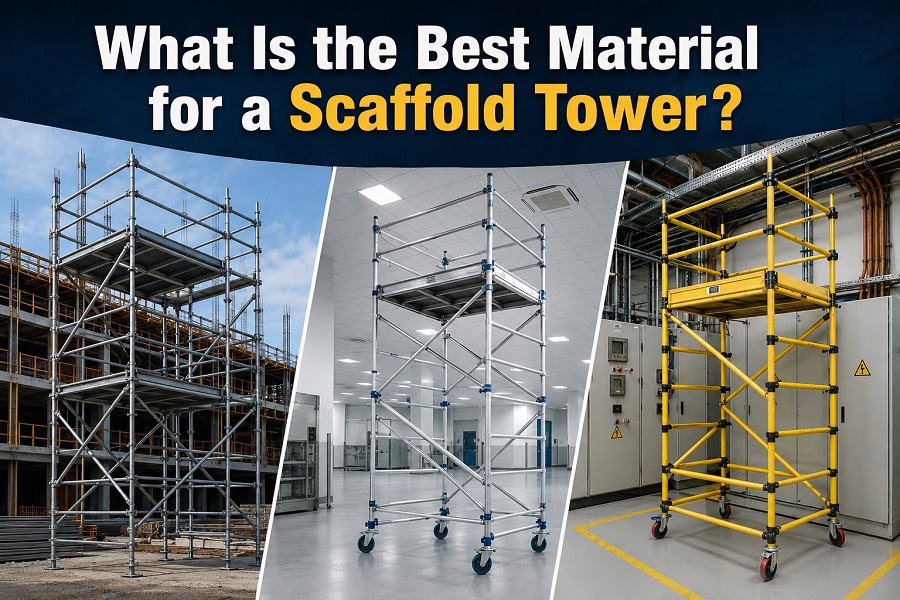
The answer depends on the application. Steel, aluminum, and fiberglass/GRP are all used for scaffold towers, but each material has different strengths and limitations. Steel offers strength and durability. Aluminum is lightweight and easy to move. Fiberglass is non-conductive and suitable for special electrical or industrial environments.
For contractors, maintenance teams, rental companies, and procurement buyers, the best choice should be based on load requirements, jobsite environment, mobility needs, corrosion exposure, electrical hazards, budget, and applicable safety standards.
Why Scaffold Tower Material Matters
The material of a scaffold tower affects more than appearance. It influences the tower’s weight, stability, load capacity, corrosion resistance, assembly efficiency, transportation cost, and long-term maintenance.
A scaffold tower is a temporary work platform, but it must still provide safe support during use. In the UK, HSE guidance emphasizes that tower scaffolds rely on all parts being in place for adequate strength and can collapse if sections are left out. It also states that towers should be used on firm, level ground, with stabilizers or outriggers installed when required by the instruction manual.
This means the material is important, but it is not the only factor. A safe scaffold tower also depends on proper design, complete components, correct assembly, inspection, and responsible use on site.
Common Materials Used for Scaffold Towers
The three most common material options for scaffold towers are:
- Stål
- Aluminium
- Fiberglass / GRP
Each material is suitable for different working conditions. There is no single “best” material for every project.
| Material | Main Advantage | Main Limitation | Best For |
| Stål | Strong, stable, durable | Heavier to move and transport | Heavy-duty construction, outdoor use, rental fleets |
| Aluminium | Lightweight, easy to assemble and move | Lower heavy-duty performance than steel in some designs | Maintenance, painting, indoor and mobile access work |
| Fiberglass / GRP | Non-conductive and corrosion-resistant | Higher cost and more specialized use | Electrical work, rail, petrochemical, sensitive environments |
Steel Scaffold Towers: Strength and Durability
Steel scaffold towers are known for strength, stability, and durability. Steel is often preferred for heavy-duty applications where the tower must support workers, tools, and materials in demanding conditions.
For construction sites, industrial maintenance, and long-term outdoor use, steel scaffold towers can be a strong choice because they offer good structural performance and resistance to impact during repeated handling. Steel is also suitable for towers that need to be used frequently by rental companies or contractors.
The main advantages of steel scaffold towers include:
- Hög hållfasthet
- Good stability
- Strong impact resistance
- Long service life with proper surface treatment
- Suitable for demanding construction environments
- Good value for repeated use
However, steel is heavier than aluminum. This can make transportation, manual handling, assembly, and storage more demanding. For a mobile tower that needs to be moved frequently by a small team, steel may not always be the most efficient option.
Steel also needs proper corrosion protection. For outdoor projects, hot-dip galvanized steel towers or galvanized components are usually preferred because they help resist rust and reduce maintenance.
Aluminum Scaffold Towers: Lightweight and Easy to Move
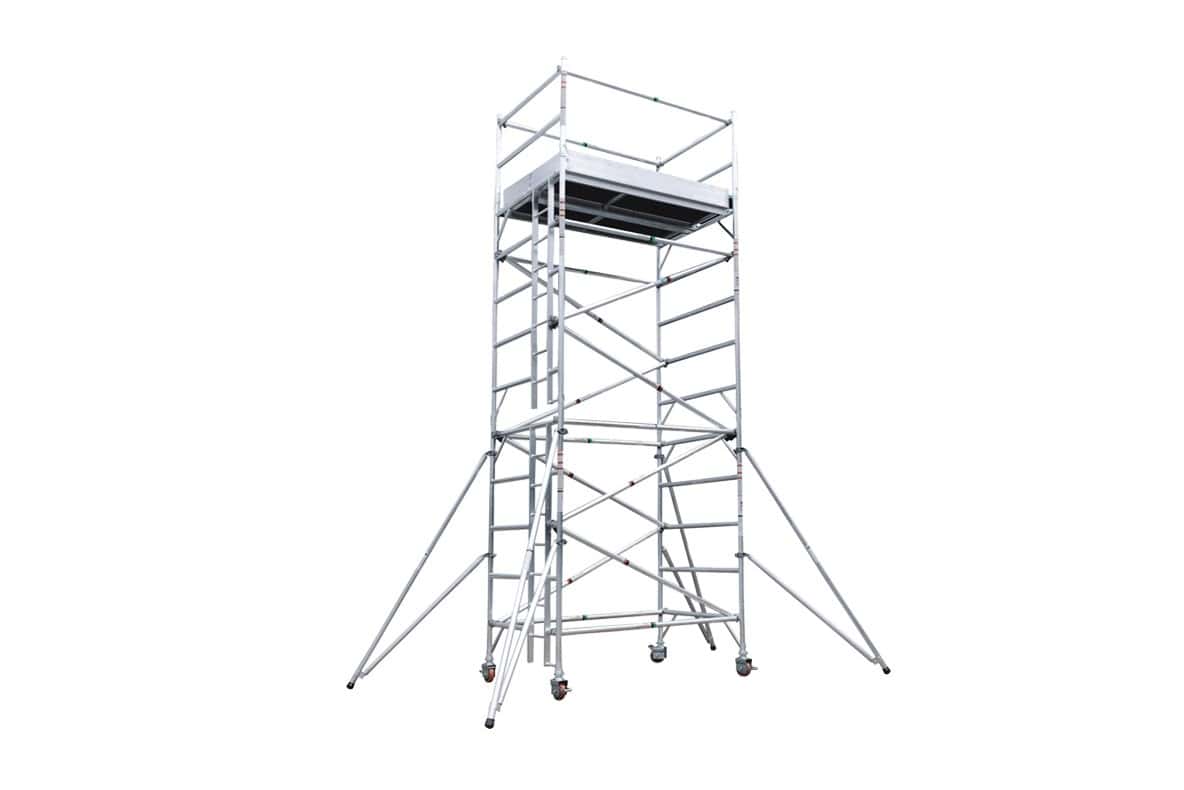
Aluminum scaffold towers are popular because they are lightweight, portable, and easy to assemble. For maintenance teams, painters, electricians, decorators, facility managers, and contractors who need frequent movement around a site, aluminum can be very practical.
Aluminum towers are commonly used for indoor and outdoor access where mobility is important. Their lighter weight can reduce handling time and make assembly and dismantling easier compared with heavier steel systems. Some mobile aluminum tower systems are designed specifically for building, construction, and maintenance access. A BoSS guide, for example, describes mobile aluminum towers as lightweight scaffold towers used for indoor and outdoor access where a stable platform is required.
The main advantages of aluminum scaffold towers include:
- Lightweight structure
- Easy transportation
- Faster assembly and dismantling
- Good corrosion resistance
- Suitable for mobile access work
- Practical for indoor and outdoor maintenance
The main limitation is that aluminum is generally not the best choice for every heavy-duty application. The actual load capacity depends on the tower design, platform rating, bracing, height, and manufacturer specifications. Buyers should always check the approved load rating instead of assuming that one material is automatically stronger than another.
Another important point is electrical safety. Aluminum is a conductive material, so it should not be selected for work near live electrical hazards unless the work environment has been properly assessed and controlled.
Fiberglass / GRP Scaffold Towers: Non-Conductive and Specialized
Fiberglass scaffold towers, also called GRP scaffold towers, are used for more specialized working environments. Their main advantage is that fiberglass is non-conductive, making it useful for work near electrical equipment or in industries where metal towers may not be suitable.
Fiberglass scaffold towers are often used in electrical, rail, petrochemical, clean room, food production, and sensitive industrial environments. One access tower supplier describes fiberglass towers as non-conductive, non-corrosive, and spark-resistant, and notes that they are preferred in rail, petrochemical, and electrical industries.
The main advantages of fiberglass scaffold towers include:
- Non-conductive material
- Corrosion resistance
- Spark-resistant properties
- Suitable for electrical and industrial environments
- Useful where metal towers may create risk
- Good for sensitive or clean working areas
The main limitations are cost and availability. Fiberglass towers are usually more specialized than aluminum or steel towers, and they may have a higher purchase price. Buyers should also check the manufacturer’s load rating, compliance documents, UV resistance, chemical resistance, and platform specifications before ordering.
Fiberglass is not automatically the best choice for every job. It is best used when the project environment requires non-conductive or corrosion-resistant access equipment.
Steel vs Aluminum Scaffold Towers
Steel and aluminum are the two most common choices for scaffold towers. The right choice depends on whether the project values strength and durability more, or lightweight mobility more.
| Faktor | Steel Scaffold Tower | Ställningstorn i aluminium |
| Strength | Strong and durable | Strong enough for many access tasks, but design-dependent |
| Vikt | Heavier | Much lighter |
| Mobility | Less convenient for frequent movement | Easier to move and reposition |
| Assembly | May require more handling effort | Usually faster and easier |
| Korrosionsbeständighet | Needs galvanizing or coating | Naturally corrosion-resistant |
| Bästa användning | Heavy-duty construction and long-term outdoor use | Maintenance, painting, indoor access, mobile work |
| Kosta | Often cost-effective for heavy-duty use | Can be higher depending on design and alloy |
For heavy-duty or repeated outdoor use, steel scaffold towers are often preferred. For light to medium-duty access work where workers move the tower frequently, aluminum scaffold towers are often more efficient.
Steel vs Fiberglass Scaffold Towers
Steel scaffold towers are suitable for strength, durability, and general construction use. Fiberglass scaffold towers are suitable for specialized safety conditions, especially where electrical conductivity is a concern.
| Faktor | Steel Scaffold Tower | Fiberglass / GRP Scaffold Tower |
| Strength | Strong and durable | Design-dependent |
| Electrical Safety | Conductive | Non-conductive |
| Korrosionsbeständighet | Needs surface protection | Good corrosion resistance |
| Kosta | Usually more common and practical | Usually more specialized and costly |
| Bästa användning | Construction, industrial access, outdoor projects | Electrical, rail, petrochemical, sensitive environments |
If the project involves electrical hazards, fiberglass may be the safer material choice. If the project is general construction or heavy-duty access, steel is often more practical.
Aluminum vs Fiberglass Scaffold Towers
Aluminum and fiberglass towers are both commonly used for mobile access, but their advantages are different.
Aluminum is preferred when lightweight handling, fast assembly, and easy movement are the main priorities. Fiberglass is preferred when non-conductive performance is required.
| Faktor | Ställningstorn i aluminium | Fiberglass / GRP Scaffold Tower |
| Vikt | Lightweight | Often heavier than aluminum, depending on design |
| Electrical Safety | Conductive | Non-conductive |
| Korrosionsbeständighet | Good | Good |
| Kosta | Often more affordable than fiberglass | Usually higher |
| Bästa användning | Maintenance, painting, facility work | Electrical and specialized industrial work |
For most general maintenance and access tasks, aluminum is usually more convenient. For electrical environments, fiberglass is usually the better choice.
Best Material for Different Applications
Best Material for Heavy-Duty Construction
For heavy-duty construction, stål is often the best choice. It offers strength, stability, and durability for demanding jobsite conditions.
Steel scaffold towers are suitable for:
- Building construction
- Industriellt underhåll
- Long-term outdoor access
- Rental fleets
- Projects requiring strong impact resistance
For outdoor use, galvanized steel is recommended to improve corrosion resistance and reduce maintenance.
Best Material for Indoor Maintenance
For indoor maintenance, aluminium is often the best choice. It is lightweight, easy to move, and fast to assemble.
Aluminum scaffold towers are suitable for:
- Painting
- Ceiling work
- Lighting maintenance
- Facility maintenance
- Warehouse access
- Commercial building repair
For teams that need to move the tower frequently, aluminum can improve work efficiency.
Best Material for Electrical Work
For electrical work, fiberglass / GRP is usually the best choice because it is non-conductive.
Fiberglass scaffold towers are suitable for:
- Electrical maintenance
- Rail projects
- Petrochemical facilities
- Work near sensitive equipment
- Areas where metal towers are not suitable
Even with fiberglass, buyers should still follow electrical safety rules, site risk assessments, and local regulations.
Best Material for Outdoor Projects
For outdoor projects, the best material depends on the job conditions.
For heavy-duty outdoor use, galvanized steel is a strong choice. For mobile outdoor maintenance, aluminium may be more convenient. For corrosive or electrical environments, fiberglass may be required.
Buyers should consider wind exposure, ground condition, load requirements, corrosion risk, transport frequency, and storage conditions.
Best Material for Rental Companies
For rental companies, steel or aluminum may both be suitable depending on the customer base.
Steel can be better for heavy-duty users and long-term durability. Aluminum can be better for customers who need lightweight, mobile access towers. A rental company may choose to stock both types to serve different applications.
If rental towers will be used outdoors frequently, surface treatment and component durability become especially important.
Standards and Safety Considerations
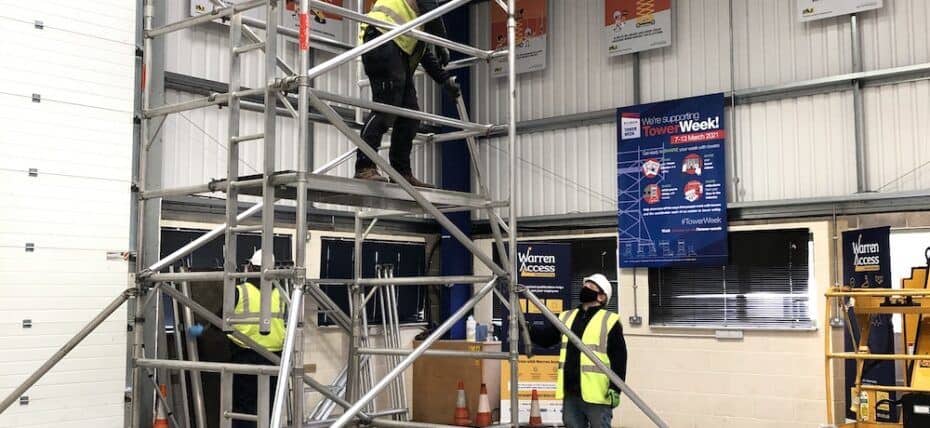
When choosing a scaffold tower, buyers should not look at material only. They should also check whether the tower meets applicable standards and safety requirements.
In Europe and the UK, BS EN 1004 is an important product standard for mobile access towers. PASMA states that EN1004 or BS EN1004 is the European product standard for mobile access towers and that towers conforming to it must meet minimum safety requirements.
BSI describes BS EN 1004-1:2020 as covering mobile access and working towers made of prefabricated elements, including materials, dimensions, design loads, safety, and performance requirements. Its scope applies to towers up to 12 m indoors and up to 8 m outdoors.
For buyers, important safety checks include:
- Applicable tower standard
- Platform load rating
- Maximum working height
- Indoor or outdoor height limit
- Guardrails and toeboards
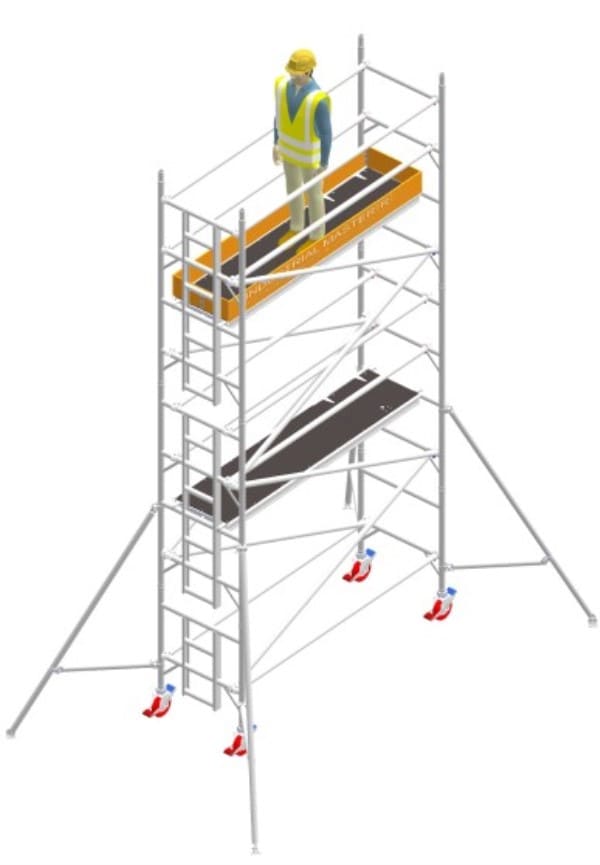
- Stabilizers or outriggers
- Access method
- Castor quality and locking system
- Assembly instructions
- Inspection requirements
- Compatibility of all components
A scaffold tower should not be mixed with incompatible parts. HSE guidance warns against using towers with broken, missing, or incompatible components.
How to Choose the Right Scaffold Tower Material
Before choosing a scaffold tower material, buyers should answer these questions:
- Will the tower be used indoors or outdoors?
- Is the project light-duty, medium-duty, or heavy-duty?
- How often will the tower be moved?
- How many workers and tools will be on the platform?
- Is there any electrical hazard nearby?
- Is the environment humid, coastal, chemical, or corrosive?
- What is the required platform height?
- Does the project require EN1004 or another standard?
- Is transportation weight a major concern?
- Is the tower for one project or long-term rental use?
- What is the maintenance plan?
The best scaffold tower material is the one that fits the job conditions. Steel, aluminum, and fiberglass can all be good choices when used in the right environment.
Slutsats
The best material for a scaffold tower depends on the job. Steel scaffold towers are strong, stable, and suitable for heavy-duty construction and long-term use. Aluminum scaffold towers are lightweight, easy to move, and ideal for maintenance and mobile access work. Fiberglass scaffold towers are non-conductive and suitable for electrical, rail, petrochemical, and specialized industrial environments.
For most buyers, the right choice should balance load capacity, mobility, corrosion resistance, electrical safety, service life, and budget. Material selection should also be checked together with tower design, platform rating, stabilizers, guardrails, inspection requirements, and applicable standards.
Looking for reliable scaffold tower solutions for your project? Contact APAC-ställning to discuss suitable scaffold tower materials, access requirements, and project applications.
FAQ About Scaffold Tower Materials
What is the best material for a scaffold tower?
There is no single best material for every scaffold tower. Steel is best for strength and heavy-duty use, aluminum is best for lightweight mobility, and fiberglass is best for non-conductive applications.
Is a steel scaffold tower better than an aluminum scaffold tower?
Steel is usually stronger and more durable for heavy-duty work, but aluminum is lighter and easier to move. The better choice depends on the project’s load requirement, mobility needs, and working environment.
Is aluminum good for scaffold towers?
Yes. Aluminum is widely used for mobile scaffold towers because it is lightweight, corrosion-resistant, and easy to assemble. It is suitable for maintenance, painting, indoor work, and many mobile access tasks.
When should I choose a fiberglass scaffold tower?
Choose fiberglass or GRP when non-conductive performance is required, such as electrical work, rail maintenance, petrochemical facilities, or environments where metal towers may create safety concerns.
Is fiberglass scaffolding safer than metal scaffolding?
Fiberglass can be safer near electrical hazards because it is non-conductive. However, scaffold safety also depends on design, load rating, assembly, inspection, and correct use.
What scaffold tower material is best for outdoor use?
For heavy-duty outdoor use, galvanized steel is often a strong choice. For mobile outdoor maintenance, aluminum may be more convenient. For electrical or corrosive environments, fiberglass may be suitable.
Should scaffold towers meet EN1004?
For European and UK markets, EN1004 is an important standard for mobile access towers. Buyers should check whether the tower meets the required local standard before purchase or use.