Introduktion
Scaffolding plays an important role in creating safe and practical access for work at height. As construction projects become larger, faster, and more complex, contractors need scaffold systems that can be assembled efficiently while adapting to different site conditions. Modular scaffolding was developed to meet these needs. With standardized components and fixed connection points, it offers a more organized way to build temporary working platforms for construction, renovation, maintenance, and industrial projects.
This article explains the main types of modular scaffolding systems and how to choose the right one for different construction and industrial applications.
What Is a Modular Scaffolding System?
A modular scaffolding system is a temporary access or support structure built from standardized components. These usually include vertical standards, horizontal ledgers, transoms, diagonal braces, scaffold planks, base jacks, and access components.
The key feature of modular scaffolding is its fixed connection design. Instead of relying heavily on individual couplers, the system uses pre-defined connection points on the standards. This allows workers to assemble the scaffold in a more regular and repeatable way.
Modular scaffolding is commonly used for:
- Building construction and renovation
- Bridge construction and maintenance
- Raffinaderier och kemiska anläggningar
- Shipbuilding and offshore projects
- Mining and power plant maintenance
- Temporary platforms for events and stages
1. Ringlock Modular Scaffolding
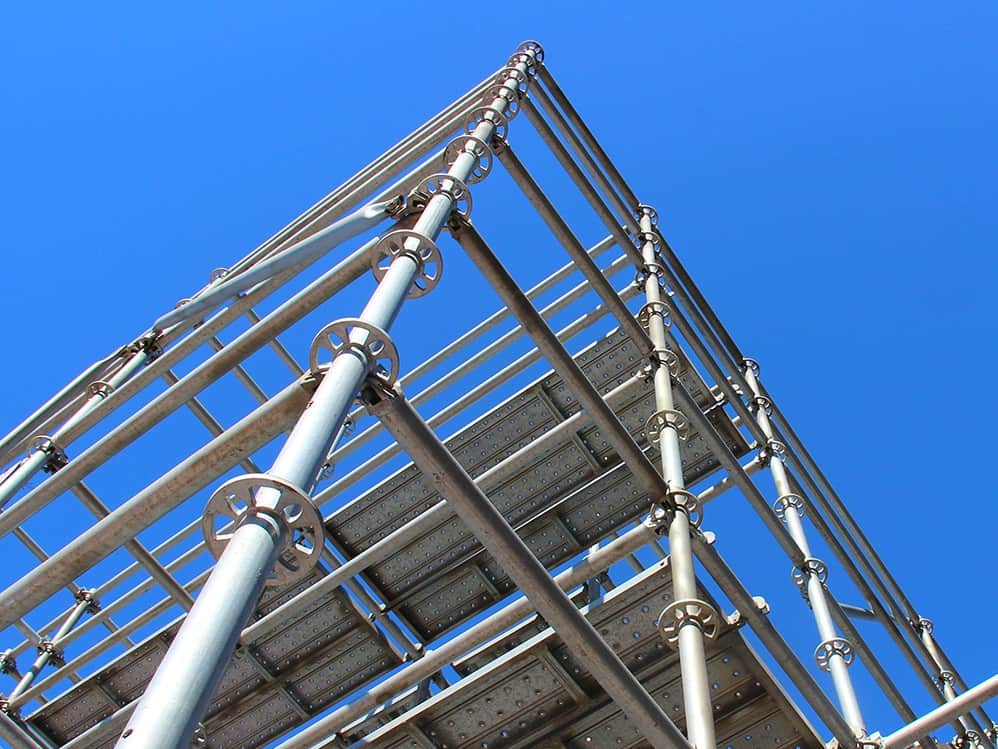
Ringlock scaffolding, also called rosette scaffolding, is one of the most flexible modular scaffolding systems. It uses vertical standards with ring-shaped rosettes welded at regular intervals. Each rosette usually has multiple punched holes, allowing ledgers and braces to be connected in different directions.
This multi-angle connection method gives Ringlock scaffolding strong adaptability. It can be used for straight, curved, circular, or irregular structures, which makes it suitable for projects where the scaffold layout is more complex.
Key Features of Ringlock Scaffolding
Ringlock scaffolding is known for its high flexibility, quick assembly, and strong structural performance. Because the connection points allow different angles, the system can adapt well to difficult building shapes and industrial structures.
It is often used in:
- Industrial plants
- Raffinaderier och kemiska anläggningar
- Shipyards
- Offshore platforms
- Bridges and infrastructure projects
- Event structures and temporary platforms
For projects that require complex access, circular layouts, or heavy-duty working platforms, Ringlock scaffolding is often a practical choice.
2. Cuplock Modular Scaffolding

Cuplock-ställningar is another widely used modular scaffolding system. Its name comes from the cup locking mechanism used to connect ledgers and transoms to the vertical standards.
Each connection point usually includes a lower fixed cup and an upper movable cup. The ledger or transom is placed into the lower cup, and the upper cup is then moved down and tightened to secure the joint. This design reduces the need for many loose fittings and makes the system simple to assemble.
Key Features of Cuplock Scaffolding
Cuplock scaffolding is valued for its simple structure, stable connection, and efficient assembly. Since up to four horizontal members can be connected at one node point, it is suitable for creating regular scaffold bays and stable support structures.
It is commonly used in:
- Building construction
- Renovation projects
- Façade access
- Formwork support
- Bridges, tunnels, chimneys, and water towers
- General civil engineering work
Compared with Ringlock, Cuplock is usually less flexible in angle adjustment, but it performs well in projects that need a strong and regular scaffold structure. You can learn more from the Cuplock-ställningar product page.
3. Kwikstage Modular Scaffolding
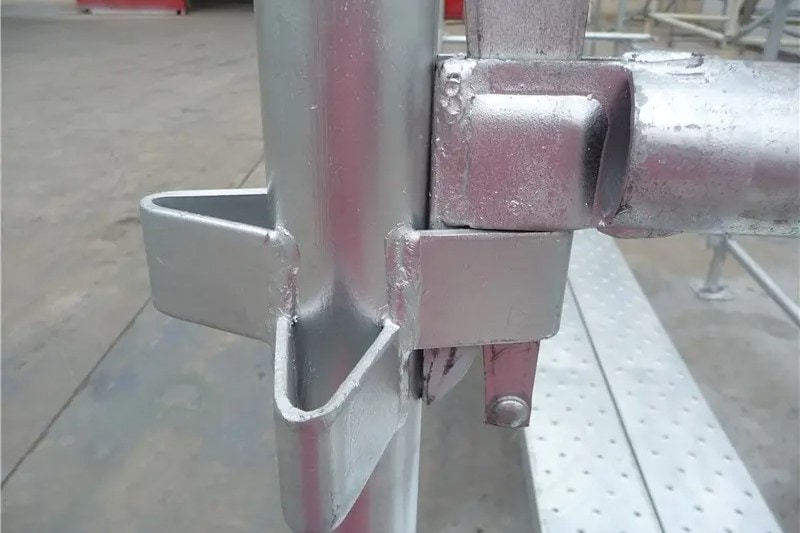
Kwikstage scaffolding, sometimes called Quick Stage scaffolding, is a modular system designed for fast and simple assembly. It is recognized by the V-shaped or triangular pressings on the vertical standards, where ledgers and transoms are connected.
Kwikstage is especially popular in Australia and New Zealand and is commonly used for light to medium-duty construction work. Its straightforward connection design makes it suitable for projects with regular layouts and repeated scaffold bays.
Key Features of Kwikstage Scaffolding
Kwikstage scaffolding is easy to handle, quick to erect, and practical for general construction access. It is often selected for projects where the structure is not too complex and where speed and simplicity are important.
It is commonly used for:
- Residential construction
- Commercial building façades
- Bricklaying
- Painting and plastering
- General maintenance work
- Light and medium-duty access scaffolding
For contractors working on standard building projects, Kwikstage scaffolding can provide a convenient and efficient access solution.
Ringlock vs Cuplock vs Kwikstage Scaffolding
Although Ringlock, Cuplock, and Kwikstage are all modular scaffolding systems, they are not used in exactly the same way.
| Scaffolding Type | Connection Method | Main Advantage | Suitable Projects |
| Ringlock-ställningar | Rosette connection | High flexibility and multi-angle layout | Industrial projects, bridges, shipyards, complex structures |
| Cuplock-ställningar | Cup locking system | Stable structure with fewer loose parts | Building construction, renovation, formwork support, civil engineering |
| Kwikstage-ställningar | Wedge / pressing connection | Simple and fast assembly | Residential, commercial façade, plastering, bricklaying |
In general, Ringlock is more suitable for complex structures, Cuplock is a good option for regular and heavy-duty support applications, and Kwikstage is practical for standard access scaffolding on light to medium-duty projects. For a more detailed comparison of the first two systems, you can also read this guide on Ringlock vs Cuplock scaffolding.

How to Choose the Right Modular Scaffolding System
Choosing the right modular scaffold depends on the project environment, load requirements, working height, and installation conditions.
For complex industrial sites, such as refineries, shipyards, or offshore platforms, Ringlock scaffolding is often preferred because of its flexible angles and strong adaptability. For regular building structures or support work, Cuplock scaffolding can provide a stable and efficient layout. For residential or commercial façade work, Kwikstage scaffolding may be easier to handle and faster to install.
Other factors to consider include:
- Required working load
- Scaffold height and bay size
- Structure shape and access points
- Ground conditions
- Assembly and dismantling time
- Local standards and project specifications
- Availability of compatible components such as byggnadsställningsplankor och scaffold base plates
Common Benefits of Modular Scaffolding Systems
Ringlock, Cuplock, and Kwikstage scaffolding share several important benefits. Since they are made from standardized components, they are easier to transport, store, assemble, and reuse across different projects.
The main benefits include:
- Faster erection and dismantling
- More consistent scaffold layout
- Fewer loose components compared with tube and coupler scaffolding
- Good stability when correctly assembled
- Flexible use across construction and industrial sites
- Reusable components for long-term project value
With proper planning and installation, modular scaffolding can improve worksite access, reduce assembly time, and support safer work at height. Quality control is also important, especially for components such as standards, ledgers, braces, platforms, and base jacks. More information is available on APAC Scaffold’s quality control page.
Slutsats
Modular scaffolding systems are widely used because they combine speed, stability, and adaptability. Among the most common types, Ringlock, Cuplock, and Kwikstage scaffolding each have different strengths.
Ringlock scaffolding is suitable for complex and heavy-duty projects. Cuplock scaffolding works well for regular structures, renovation, and support applications. Kwikstage scaffolding is a practical choice for light and medium-duty access work, especially on residential and commercial building projects.
Understanding the differences between these systems helps contractors choose a scaffold that fits the project structure, working load, and site conditions. For more details about modular scaffolding products, visit APAC Scaffold’s scaffolding solutions.
FAQs About Modular Scaffolding Systems
1. What is a modular scaffolding system?
A modular scaffolding system is a temporary access or support structure made from prefabricated components, such as standards, ledgers, transoms, braces, base jacks, and scaffold planks. These components are connected at fixed node points, making the scaffold easier to assemble, dismantle, transport, and reuse compared with traditional tube and coupler scaffolding.
2. What are the main types of modular scaffolding systems?
The main types of modular scaffolding systems include Ringlock scaffolding, Cuplock-ställningaroch Kwikstage scaffolding. Each system has a different connection method and is suitable for different project requirements, such as industrial maintenance, building construction, renovation, façade work, and infrastructure projects.
3. What is the difference between Ringlock and Cuplock scaffolding?
Ringlock scaffolding uses a rosette connection system, which allows ledgers and braces to be installed at different angles. This makes it more flexible for complex structures. Cuplock scaffolding uses a cup-locking mechanism, which is simple, stable, and efficient for regular scaffold layouts and support structures.
4. Which modular scaffolding system is best for complex structures?
Ringlock scaffolding is often preferred for complex structures because its rosette connection allows multi-angle assembly. It is suitable for industrial plants, refineries, shipyards, bridges, offshore projects, and other sites where the scaffold needs to adapt to irregular shapes or complicated access requirements.
5. Is Kwikstage scaffolding suitable for heavy-duty projects?
Kwikstage scaffolding is generally suitable for light and medium-duty projects, such as residential construction, commercial façades, bricklaying, painting, plastering, and general maintenance work. For heavy-duty or highly complex projects, Ringlock or Cuplock scaffolding may be more suitable depending on the load requirements and site conditions.
6. How do I choose the right modular scaffolding system?
To choose the right modular scaffolding system, consider the project type, structure shape, working height, load capacity, assembly speed, site conditions, and local safety standards. Ringlock is suitable for complex access, Cuplock is practical for stable and regular structures, and Kwikstage is often used for standard construction access.