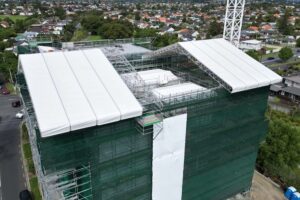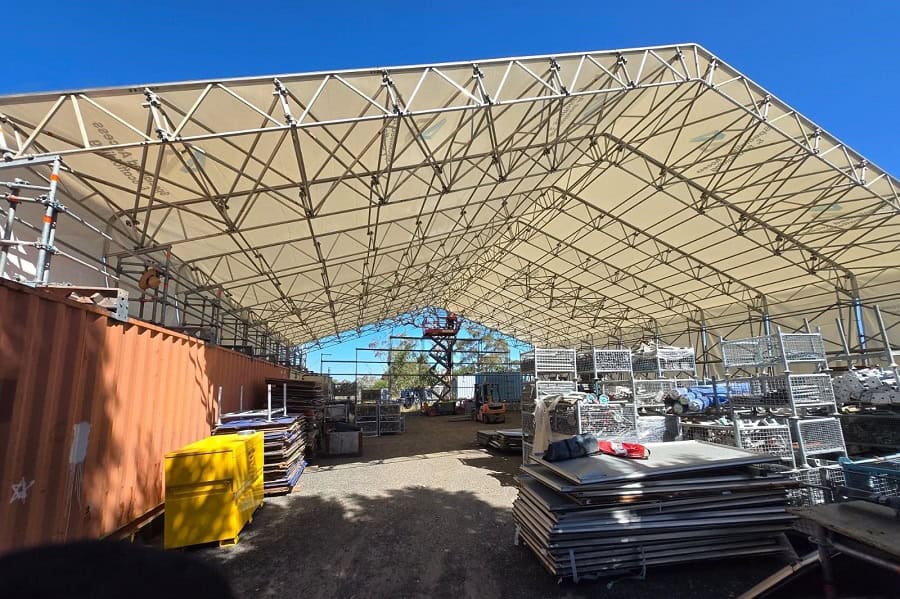
مقدمة
A Keder roof may be supported by aluminium beams, braces and scaffold structures, but the part directly exposed to rain, wind, sunlight and changing temperatures is the Keder roof sheeting.
At first glance, it can look like a relatively simple PVC sheet. In practice, material construction, fabric weight, tensile strength, fire performance and welding quality can all affect how reliably that sheet performs during a construction project.
Understanding these differences makes it easier to specify the right sheeting instead of simply choosing the heaviest option available.
What Is Keder Roof Sheeting?
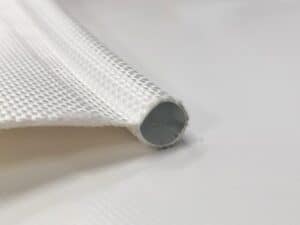
Keder roof sheeting is a reinforced flexible membrane used to cover temporary roof structures.
Unlike conventional tarpaulins that are normally tied, strapped or clamped to scaffolding, Keder sheets have a continuous Keder bead along their edges. The bead slides into a corresponding track built into the aluminium roof beam.
Once several sheets are installed side by side, they create the weather-protection layer across the temporary roof.
This method has several practical advantages:
- The sheet is continuously supported along its edges.
- Fewer loose fixing points are exposed to wind.
- Sheets can be pulled along the tracks during installation.
- Individual sheets can be replaced if damaged.
- A relatively smooth roof surface can be created for water runoff.
The idea is simple, but performance depends heavily on what the sheet itself is made from and how it has been manufactured.
What Is Keder Roof Sheeting Made From?
A common construction is polyester fabric coated with PVC on both sides.
The polyester provides the reinforcing structure. The PVC coating provides the external surface that helps make the sheet waterproof, cleanable and resistant to environmental exposure.
For example, APAC Keder sheeting uses PES polyester with double-sided PVC coating and is available with UV-stabilised and anti-mildew treatment.
Other temporary-roof products on the market use similar reinforced fabrics, combining woven polyester reinforcement with waterproof PVC coatings.
This reinforced construction matters because a roof sheet does much more than stop rain.
During use, it may experience:
- Tension during installation
- Repeated wind loading and flutter
- Abrasion during handling
- Folding and rolling during transport
- Exposure to sunlight
- Low and high temperatures
- Repeated installation and removal
The quality of the reinforcement and coating therefore matters just as much as the appearance of the finished sheet.
What Does GSM Mean for Keder Sheeting?
One specification buyers frequently see is GSM, or grams per square metre.
You may encounter Keder roof sheets rated at 300 gsm, 600 gsm, 650 gsm, 850 gsm or other weights depending on the product and intended application.
APAC, for example, supplies Keder roof sheeting in 650 gsm and 850 gsm options.
It is tempting to assume:
Higher GSM = stronger and better sheeting.
That is only partly true.
A heavier sheet normally contains more material and may be suited to demanding or longer-term applications. But GSM alone does not tell you the complete strength of the sheet.
Two sheets with similar weights can perform differently because of:
- Polyester yarn quality
- Fabric weave
- PVC coating thickness
- Tensile strength
- Tear resistance
- Quality of the welded joints
- Keder attachment design
- UV stabilisation
- Manufacturing consistency
For this reason, buyers should compare GSM together with mechanical properties rather than treating weight as the only measure of quality.
650 GSM vs 850 GSM: Which Should You Choose?
There is no universal rule that every project needs the heaviest possible sheet.
A 650 gsm reinforced PVC sheet can already be suitable for many temporary-roof applications. A heavier 850 gsm option may be considered when additional robustness is required, particularly where sheeting will face frequent handling or extended exposure.
The decision should consider several factors.
Project Duration
A roof protecting a short refurbishment project may have very different requirements from a temporary enclosure expected to remain installed for many months.
Exposure
An exposed construction site can subject sheeting to greater wind action than a sheltered urban location.
Reuse
Rental fleets and contractors planning to use the same sheeting repeatedly may place more emphasis on handling resistance and long-term durability.
Sheet Size
Long sheets are heavier to pull through a track and more difficult to handle. Increasing material weight also increases the total mass installers must manage.
This creates a balance.
A heavier sheet can provide additional robustness, but unnecessary weight can make installation, transport and storage more difficult.
The right question therefore is not:
“What is the heaviest sheet available?”
It is:
“What sheet specification suits the conditions and service life of this temporary roof?”
Tensile Strength and Tear Resistance Matter Too
GSM should always be considered together with tensile strength and tear resistance.
Tensile strength describes the force the material can resist when it is being pulled.
This becomes important because Keder sheets are tensioned during installation and remain exposed to loads while installed.
Tear resistance describes how well the material resists an existing cut, puncture or damaged area from continuing to tear.
This matters on construction sites because damage does not always begin with a dramatic failure. It may start as a small cut caused by handling, a sharp scaffold component or poor storage.
Wind movement can then repeatedly load that damaged point.
A high-quality temporary roof sheet therefore needs more than simply sufficient thickness. It needs a reinforcement structure capable of distributing forces through the material.
The Keder Weld Is One of the Most Important Areas
The PVC membrane itself is only one part of the system.
The Keder bead must also remain securely connected to the sheet because this is where loads are transferred into the aluminium track.
Keder typically consists of a flexible core wrapped in compatible fabric. This assembly is then welded to the main roof sheet.
For PVC-coated materials, high-frequency or radio-frequency welding is commonly used to create the connection.
Why does this matter?
Because a sheet can have excellent base-fabric specifications but still perform poorly if the welding around the Keder is inconsistent.
When evaluating a supplier, it is therefore worth looking at:
- Weld width
- Weld consistency
- Alignment of the Keder bead
- Reinforcement around sheet ends
- Keder diameter tolerance
- Compatibility with the roof track
For Keder roofing, dimensional accuracy is particularly important. A bead that does not match the extrusion correctly can make installation unnecessarily difficult and may affect how smoothly the sheet moves through the track.
Is Keder Roof Sheeting Fireproof?
This is an important distinction.
Flame-retardant does not mean fireproof.
PVC-coated Keder sheeting is still an organic material. Fire-retardant treatments and material formulations are intended to improve its reaction to fire, not make the sheet incapable of burning under all circumstances.
Different markets may also reference different fire-test classifications.
One commonly used European classification system is EN 13501-1, which classifies construction products according to their reaction to fire.
A classification may appear as:
B-s1,d0
The three parts provide different information:
- B — reaction-to-fire class
- s1 — low smoke production within the classification system
- d0 — no flaming droplets or particles within the relevant test criteria
DIN 4102 B1 is another classification frequently seen on temporary-roof sheeting specifications.
APAC Keder roof sheeting, for example, is available with fire-performance options tested according to standards such as DIN 4102 B1 and EN 13501-1 B-s1,d0.
However, buyers should not simply see the letters “FR” and assume all flame-retardant sheets are equivalent.
Always Check the Actual Fire Test Documentation
Fire performance should be treated as a documented specification.
Ask the supplier:
- Which standard was tested?
- What exact classification was achieved?
- Which sheet material and weight were tested?
- Is a test report available?
- Does the tested product match the product being supplied?
This final question is especially important.
Fire-test classifications apply to specific tested materials and configurations. A test result for one type of sheet should not automatically be assumed to cover every material weight, construction or product variation.
For procurement teams, this means that “fire retardant” should never replace supporting documentation when a project has a specific fire-performance requirement.
What Determines the Durability of Keder Roof Sheeting?
Durability is not determined by one specification.
A Keder sheet normally deteriorates through a combination of environmental exposure, mechanical damage and repeated handling.
Several factors deserve attention.
UV Exposure
Temporary roofs may remain outdoors for months.
Without suitable UV stabilisation, prolonged sunlight can gradually affect PVC-coated materials, potentially reducing flexibility and accelerating surface ageing.
For longer installations, UV-resistant material should therefore be part of the specification.
Wind Movement
Wind does not simply push against a temporary roof once.
It creates repeated pressure and suction cycles.
Poorly tensioned sheeting can move or flutter excessively, increasing fatigue around edges, welds and already damaged areas.
This is why the roof structure, sheeting and installation method should always be considered together.
Temperature
Temporary roofs operate outdoors, sometimes through very different seasons.
Cold temperatures can make some flexible materials harder to handle, while prolonged heat and sunlight can contribute to material ageing.
The expected environmental conditions should therefore be considered when selecting the sheet.
Installation Damage
One of the most avoidable causes of sheet damage occurs during installation.
Dragging sheets over rough surfaces, forcing a damaged Keder through a track, pulling around sharp corners or installing sheets through contaminated Keder tracks can damage otherwise good material.
Cleaning and inspecting the track before pulling the sheet can make a significant difference.
تخزين
A reusable sheet may spend almost as much time in transport and storage as it does installed on a roof.
Sheets should be kept clean, dry and protected from sharp objects.
Before reuse, inspect the Keder bead, welded areas and sheet surface rather than assuming that a sheet removed in good condition remains ready for the next project.
What Should Buyers Check Before Ordering?
When comparing Keder roof sheeting, do not make the decision from GSM alone.
Look at the complete specification:
- Base fabric and coating material
- Sheet weight
- Tensile strength
- Tear resistance
- UV resistance
- Fire-test classification
- Available test documentation
- Keder diameter
- Keder welding method
- Track compatibility
- Sheet width and length
- Repairability and expected reuse
- Manufacturing tolerances
Most importantly, make sure the sheet and roof system are compatible.
A very strong sheet cannot compensate for the wrong Keder diameter, poor track alignment or a temporary roof that has not been designed for the loads at its location.
خاتمة
Keder roof sheeting may look like one of the simpler parts of a temporary roof, but it has a demanding job. It needs to remain flexible enough to install, strong enough to withstand repeated loading, waterproof enough to protect the work below and durable enough to survive outdoor exposure and repeated use.
That is why choosing Keder sheeting should never come down to a single figure such as GSM. Material construction, tensile and tear strength, Keder welding, dimensional accuracy, fire-performance documentation and the conditions of the actual project all matter.
Ultimately, a reliable temporary roof does not depend on one strong component. The aluminium beams, tracks, Keder bead and roof sheeting need to work together as one compatible system.
FAQs About Keder Roof Sheeting
What is Keder roof sheeting used for?
Keder roof sheeting is used as the weather-protection membrane on temporary roofing systems. It is commonly used on construction, refurbishment, renovation and maintenance projects where the working area needs protection from rain and other environmental exposure.
Is Keder sheeting waterproof?
PVC-coated polyester Keder sheeting is designed to provide a waterproof covering when correctly manufactured, installed and connected as part of a properly designed temporary roof system.
However, the overall weather resistance of the roof also depends on sheet joints, end details, roof pitch, drainage and installation quality.
What does GSM mean in Keder roof sheeting?
GSM means grams per square metre and describes the weight of the material.
A higher GSM usually means more material is used in the sheet, but it does not automatically mean the sheet has better overall performance. Tensile strength, tear resistance, coating quality, reinforcement and welding should also be considered.
Is 850 gsm Keder sheeting better than 650 gsm?
Not necessarily.
An 850 gsm sheet is heavier and may offer additional robustness for demanding applications, while 650 gsm sheeting can be suitable for many temporary-roof projects.
The better choice depends on project duration, exposure, reuse requirements, handling conditions and the design of the roof system.
Is Keder roof sheeting fireproof?
No. Keder roof sheeting should not normally be described as fireproof.
Some products are manufactured with flame-retardant properties and tested according to standards such as EN 13501-1 or DIN 4102.
Buyers should check the actual classification and supporting test documentation for the specific material being supplied.
Can Keder roof sheeting be reused?
Yes. Good-quality Keder sheeting is commonly reused across multiple projects if it remains in suitable condition.
Its service life depends on UV exposure, handling, installation practices, wind exposure, storage conditions and the number of installation cycles.
Sheets should always be inspected before being installed again.
Can damaged Keder roof sheeting be repaired?
Minor damage to some PVC-coated sheets can sometimes be repaired using suitable PVC repair materials or welding methods.
However, damage around the Keder bead, welded edge or other highly loaded areas may require more careful assessment.
Where there is uncertainty about whether a repaired sheet remains suitable for use, the supplier or temporary works engineer should be consulted.
Why can Keder sheeting become difficult to pull through the roof track?
Several factors can increase pulling resistance, including dirt inside the track, damaged Keder beads, incorrect Keder diameter, poor weld alignment, bent aluminium tracks or misalignment between roof beams.
The problem is therefore not always caused by the sheet itself. Keder sheeting and aluminium tracks need to be manufactured and installed as compatible parts of the same system.