Introduction
Scaffolding planks are a fundamental component of temporary access systems in construction, industrial maintenance, and infrastructure development. These planks, also known as scaffold boards or walkboards, form the working platform on which personnel, tools, and materials are positioned. Selecting the appropriate type of scaffolding plank is critical not only for compliance with safety standards but also for optimizing load performance, durability, and cost-efficiency.
This guide outlines the different types of scaffolding planks, organized by material and structural design, and provides practical insight into their technical characteristics and suitable applications.
Classification by Material

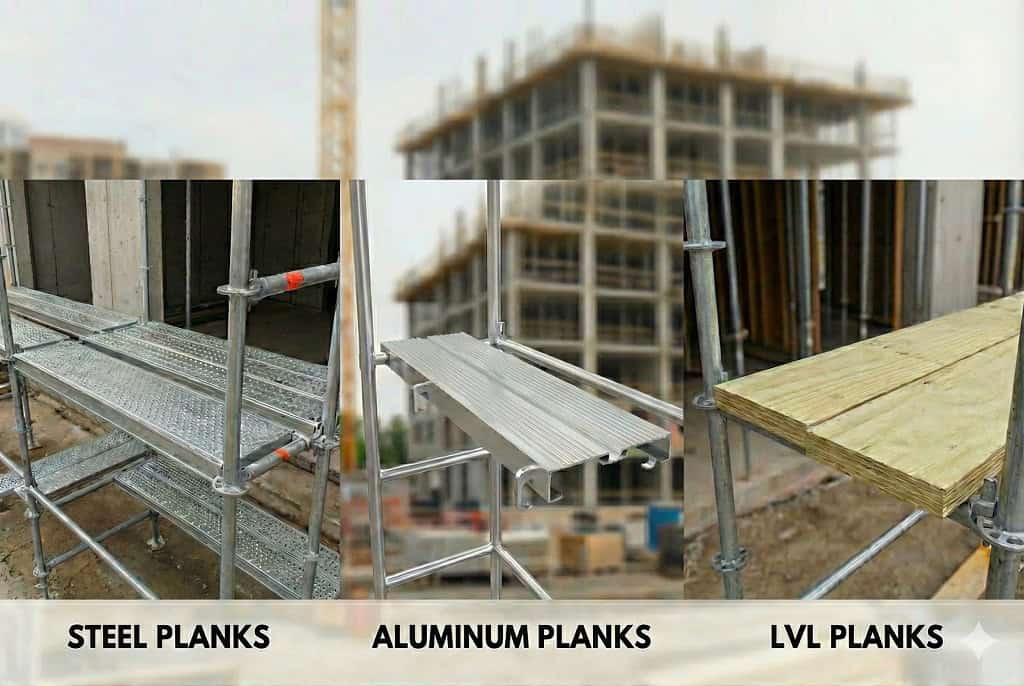
Steel Scaffolding Planks
Steel scaffolding planks are designed for applications requiring high structural capacity, durability under cyclical loads, and resistance to corrosion. Typically manufactured from high-tensile steel (≥ S235 or S355 grade), these planks are often galvanized to extend service life in outdoor or industrial settings.
💡 APAC Safety Note: Our steel planks are strictly manufactured to S235/S355 grades to ensure structural integrity. [View Our Steel Plank Specifications]
Engineering Specifications:
- Yield strength: ≥ 235 MPa (standard), up to 355 MPa for reinforced models
- Surface treatment: Hot-dip galvanization to ISO 1461 or ASTM A123
- Available with punched, serrated, or embossed anti-slip surface
- Compatible with ringlock, cuplock, and tube & clamp systems
Use Cases: Shipbuilding, petrochemical scaffolds, offshore platforms, heavy infrastructure works
Aluminum Scaffolding Planks
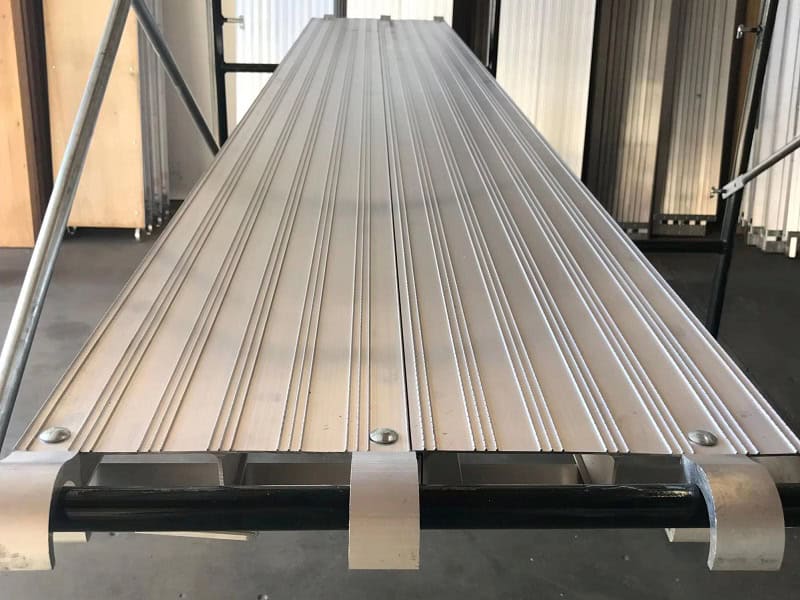
Extruded aluminum scaffold planks offer a lightweight solution for mobile scaffolds and temporary works. Manufactured using 6061-T6 or 6082-T6 alloy, they provide a good strength-to-weight ratio and intrinsic corrosion resistance—critical in humid and coastal environments.
Engineering Specifications:
- Weight: ~6–8 kg/m depending on cross-section
- Alloys: 6061-T6, 6082-T6 with yield strengths >250 MPa
- Surface finish: Mill-finished or anodized for durability
- Integrated side hooks, slip-resistant tread patterns
- Expansion coefficient considerations for outdoor use
Use Cases: Glass façade maintenance, mobile towers, temporary roofing access, fit-out and interior scaffolds
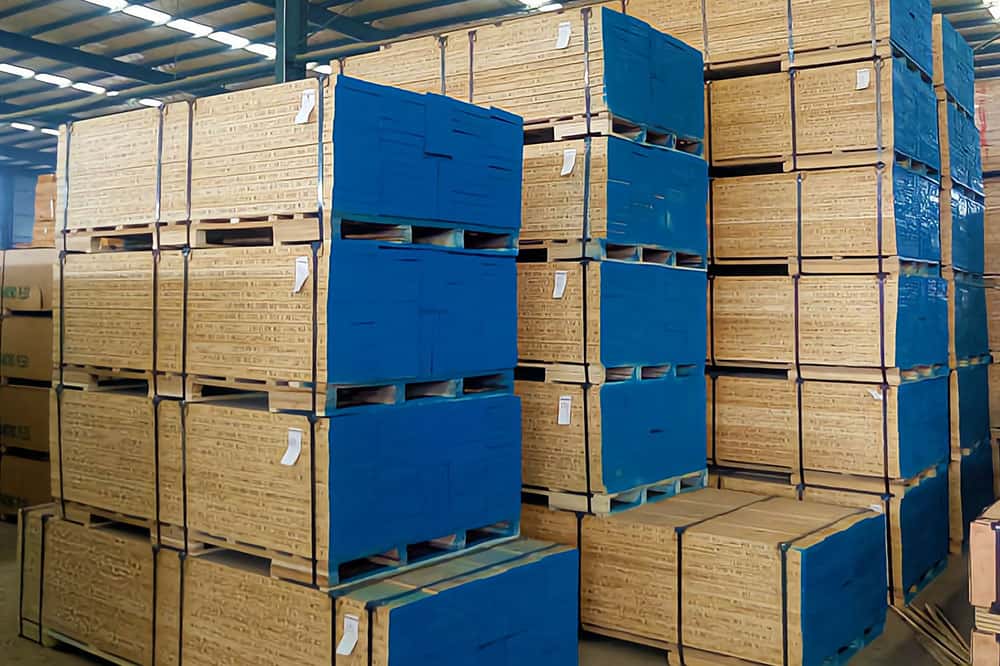
Laminated Veneer Lumber (LVL) Planks
LVL scaffold boards are structural engineered wood products developed for consistent mechanical performance. Designed according to EN 14279 or AS/NZS 4357, they offer advantages over solid-sawn timber in terms of uniformity, dimensional stability, and load capacity.
Engineering Specifications:
- Bending strength: 44–50 MPa
- Modulus of Elasticity (MOE): ~13,000 MPa
- Treated with preservatives (e.g., CCA or LOSP) to resist moisture and fungi
- Requires regular inspection for surface cracks or delamination under long-term use
- Moisture content typically controlled below 15%
Use Cases: Formwork decking, enclosed interior scaffolds, educational/institutional construction sites
Planks in Different Scaffolding Configurations
While scaffolding planks themselves are standardized components, their installation method varies significantly depending on the structural configuration of the scaffold. Understanding these configurations is crucial for determining the required plank length, support span, and load distribution.
A. Planks in Single Scaffolding (Bricklayers' Scaffolding)
Single scaffolding is predominantly used in brick masonry. In this configuration, the scaffold relies on the building wall for support. The working platform—formed by the scaffolding planks—is supported by putlogs. One end of the putlog is fixed to the ledger (approx. 1.2m from the wall), and the other end is inserted directly into a hole left in the wall.
- Implication for Planks: Since putlogs are spaced to accommodate brickwork, standard plank lengths must be carefully selected to match the putlog spacing to ensure safe overlap and support.
B. Planks in Double Scaffolding (Independent Scaffolding)
Double scaffolding is self-supporting and does not rely on the wall, making it ideal for stone masonry or finished facades where holes cannot be drilled. It features two parallel rows of standards. The scaffolding planks rest on transoms that bridge the inner and outer ledgers.
- Implication for Planks: This configuration offers greater flexibility in platform width and load capacity. It is the preferred setup for heavy-duty steel planks in industrial projects, as the double-row structure can better support the higher dead weight of steel boards compared to a single scaffold.
Comparative Performance Analysis
Different types of scaffolding planks exhibit varying characteristics in terms of strength, durability, weight, resistance to environmental conditions, and maintenance requirements. Choosing the correct material depends on a careful evaluation of the operational demands, site conditions, and compliance obligations. For instance, steel planks may be indispensable in industrial and offshore projects due to their strength and fire resistance, while aluminum planks are preferred where speed and weight reduction are critical. LVL planks, as engineered wood products, offer a balance of performance and cost for interior or lower-load applications.
The following table summarizes the comparative performance of common scaffolding plank materials:
Property | Steel Planks | Aluminum Planks | LVL Planks |
Load Capacity | Very High | Medium to High | Medium |
Weight | High | Low | Medium |
Corrosion Resistance | Excellent (galvanized) | Excellent (natural) | Moderate (treated only) |
Lifespan | 15+ years | 10–15 years | 5–10 years |
Fire Resistance | Excellent | Excellent | Limited |
Maintenance Needs | Low | Low | Medium |
Best Use | Industrial, offshore | Mobile, residential | General construction |

Key Considerations for Selecting Scaffold Planks
Selecting appropriate scaffolding planks requires a multidimensional assessment of project-specific factors. While structural strength is often the primary concern, additional parameters such as environmental exposure, assembly logistics, compatibility with existing systems, and code compliance play an equally critical role. Each site presents unique operational challenges, and improper plank selection may result in reduced efficiency, higher maintenance demands, or even safety violations. The following considerations provide a framework for informed decision-making:
- Design Load Requirements: Evaluate the maximum anticipated live and dead loads, including concentrated point loads from personnel, equipment, and stored materials. Verify that the plank type and span meet or exceed required design loads according to local scaffolding codes or international standards (e.g., EN12811, AS/NZS 1577).
- Environmental Exposure: Site conditions such as high humidity, coastal atmosphere, chemical exposure, and temperature extremes can accelerate material degradation. Steel planks with galvanization are recommended for corrosive environments, while aluminum is preferable for wet climates due to its natural oxidation resistance. LVL planks should be avoided in continuously damp conditions unless properly treated.
- Regulatory Compliance: All scaffold planks must conform to applicable regional and international codes. This includes specifications for deflection limits, anti-slip surface characteristics, and safe working load ratings. Third-party certifications and documentation should be reviewed as part of the procurement process.
- System Compatibility: Ensure that plank dimensions, locking mechanisms, and support spans are compatible with the scaffold type being used (e.g., ringlock, cuplock, frame scaffolding). Mismatched systems may cause unstable platforms or premature wear.
- Handling and Logistics: Consider the ease of transport, manual handling risks, and installation complexity. Aluminum planks offer advantages in mobility and are easier to deploy in congested or elevated work zones.
- Service Life and Maintenance: Evaluate expected lifespan under site conditions, as well as inspection and maintenance protocols. Steel and aluminum offer longer operational life with lower maintenance; wood-based LVL requires more frequent inspection for moisture damage, delamination, or warping.
- Cost-Benefit Analysis: While upfront cost is a factor, lifecycle costing—including durability, reuse potential, and frequency of replacement—provides a more accurate basis for decision-making. Avoiding the lowest-cost option in favor of materials with verified long-term performance often leads to higher overall project efficiency.
Conclusion
Understanding the structural and material differences among scaffolding planks is essential for designing safe and functional access systems. Each type—steel, aluminum, or engineered wood—offers distinct performance characteristics that should be evaluated in relation to specific site conditions and regulatory requirements.
A systematic approach to plank selection, based on engineering criteria and project needs, helps ensure both compliance and efficiency in scaffold design.
Ready to Procure High-Quality Scaffolding Components? Whether you need lightweight aluminum boards for a mobile tower or heavy-duty steel planks for an offshore rig, APAC Safety provides factory-direct pricing with uncompromising quality control.