Introduction
When people talk about the future of scaffolding, the conversation often starts with product design, steel prices or new systems.
But in reality, the future of the scaffolding industry starts somewhere else.
It starts with what the world is building.
Every new bridge, factory, apartment block, power facility or metro project creates a different access challenge. Somewhere behind the finished structure, there is often a temporary system that helped workers reach the place where the real work had to happen.
That is why changes in global construction matter so much to the scaffolding industry.
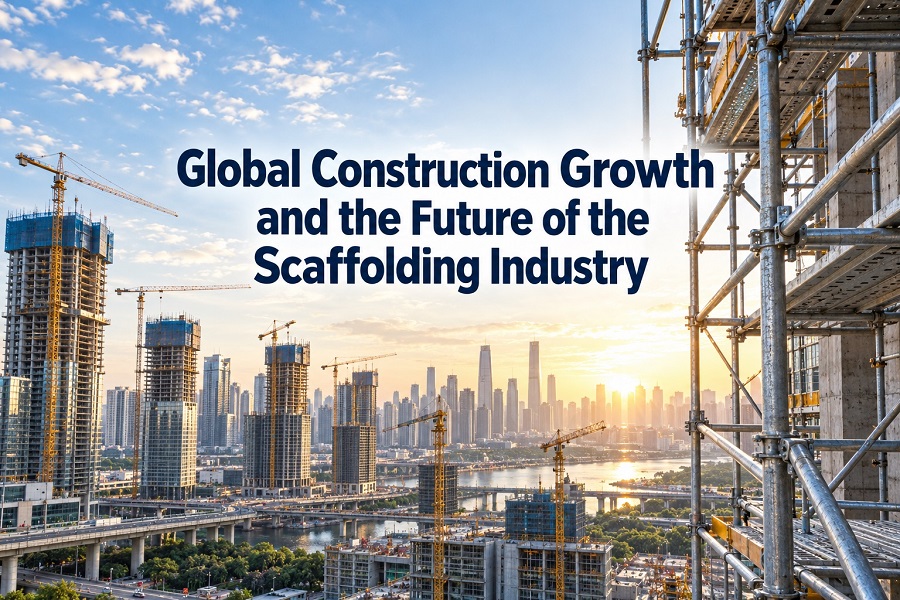
After a difficult 2025, construction activity is expected to return to growth in 2026. But the next stage of scaffolding demand will not simply come from “more buildings.” It will come from a broader mix of infrastructure, cities, energy projects and increasingly complex construction environments.
Global Construction Is Returning to Growth
The past year has not been equally easy for every construction market.
Weakness in Chinese real estate, high financing costs and uncertainty in several major economies all affected construction activity during 2025.
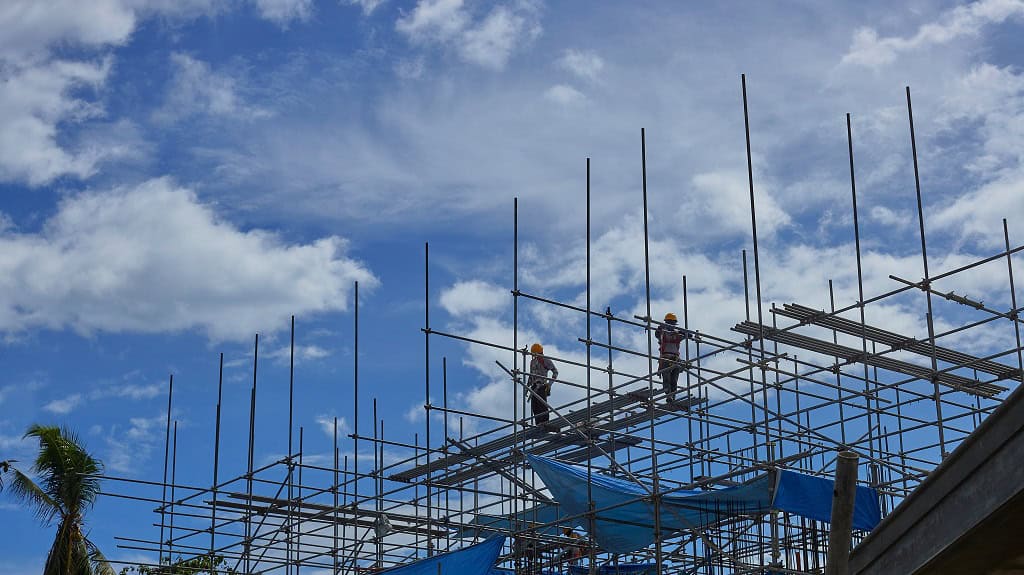
For 2026, however, Oxford Economics forecasts global construction activity to rebound by 2.9%. It also expects civil engineering to remain an important growth driver, with Southeast Asia containing some of the faster-growing construction markets.
Oxford Economics — Construction Key Themes 2026
For the scaffolding industry, this matters because construction demand is much wider than residential development.
A scaffold may be needed beside a new apartment tower one day and around a refinery, bridge or railway station the next.
Demand can come from:
- Commercial and residential buildings
- Bridges and transport infrastructure
- Industrial plants
- Power and utility projects
- Renovation work
- Industrial maintenance
This diversity is important.
The scaffolding market does not depend on one single type of construction project. When one sector slows, another can create new demand.
The Global Scaffolding Market Is Still Growing
The scaffolding market itself is also expected to expand.
According to Fortune Business Insights, the global scaffolding market was valued at USD 57.14 billion in 2025 and is projected to reach USD 59.81 billion in 2026.
The same research forecasts the market to reach USD 79.60 billion by 2034, with a CAGR of around 3.6% from 2026 to 2034.
Asia Pacific represented an estimated 40.9% of the global market in 2025.
Fortune Business Insights — Global Scaffolding Market Report
| Market Indicator | Value |
| 2025 Global Market | USD 57.14 billion |
| 2026 Estimated Market | USD 59.81 billion |
| 2034 Forecast | USD 79.60 billion |
| 2026–2034 CAGR | 3.6% |
These numbers are useful, but they only tell part of the story.
For someone working in scaffolding, the more interesting question is not simply:
“How big will the market become?”
It is:
“What kind of projects will need scaffolding next?”
That is where the industry is changing.

Infrastructure Is Becoming More Important
For many years, conversations about construction growth focused heavily on housing and commercial property.
Infrastructure is now becoming harder to ignore.
Oxford Economics expects civil engineering to remain one of the important drivers of construction growth in 2026, with investment increasingly moving toward utilities as well as traditional transport infrastructure.
That can mean projects such as:
- Bridges
- Rail and metro systems
- Power facilities
- Water infrastructure
- Industrial plants
- Stations and terminals
These projects are often very different from a standard building façade.
There may be limited access, unusual geometry, large spans, pipes, equipment or work areas that change as the project progresses.
This is where adaptable scaffolding systems become especially valuable.
Ringlock scaffolding, tube-and-coupler scaffolding and other flexible access solutions can be configured around conditions that are difficult to solve with a simple repetitive layout.
For scaffold suppliers, infrastructure growth therefore does not just mean more demand.
It may mean demand for more adaptable demand.
Cities Will Keep Creating New Construction Needs
Another long-term force behind construction is urbanization.
According to the United Nations World Urbanization Prospects 2025, cities were home to around 45% of the world’s 8.2 billion people in 2025.
The UN also expects around two-thirds of global population growth between 2025 and 2050 to occur in cities.
United Nations — World Urbanization Prospects 2025
It is easy to hear “urbanization” and think only of high-rise buildings.
But a growing city needs much more than apartments.
It needs:
- Transport
- Hospitals
- Schools
- Commercial buildings
- Utilities
- Warehouses
- Industrial facilities
And almost every one of these creates construction, maintenance or access requirements.
From a scaffolding perspective, this is important because city growth creates many different types of work rather than one single market.
A supplier may be serving façade construction, bridge maintenance, plant access and public infrastructure within the same region.
That variety is likely to become more common.
Energy and Industrial Projects Are Another Important Area
Energy investment is also changing the construction landscape.
The International Energy Agency expects global energy investment to reach USD 3.4 trillion in 2026, around 5% higher than in 2025.
Approximately USD 2.2 trillion is expected to go toward areas including renewables, nuclear power, electricity grids, storage, efficiency and electrification.
IEA — World Energy Investment 2026
Of course, not every dollar of this investment becomes construction spending.
But behind these numbers are real projects: plants, substations, grids, industrial facilities and maintenance programs.
And these are often the environments where scaffolding becomes more complicated.
Workers may need access around:
- Pipes
- Tanks
- Vessels
- Processing equipment
- Structural steel
- Restricted work areas
Anyone who has worked around an industrial scaffold knows that the clean geometry shown on a drawing does not always survive contact with the real site.
There is often a pipe exactly where a standard should go.
There is a valve that still needs access.
There is equipment that cannot be moved.
That is why flexibility matters so much in industrial scaffolding.
Modular Scaffolding Will Continue to Matter
Construction growth does not simply mean contractors need more scaffold.
It also means they need to manage more scaffold.
For rental companies and large contractors, the practical questions are often very ordinary:
Can the components be identified quickly?
Can the scaffold be erected without unnecessary complexity?
Can damaged parts be replaced easily?
Can the same equipment move from one project to another?
Can the yard team manage the inventory efficiently?
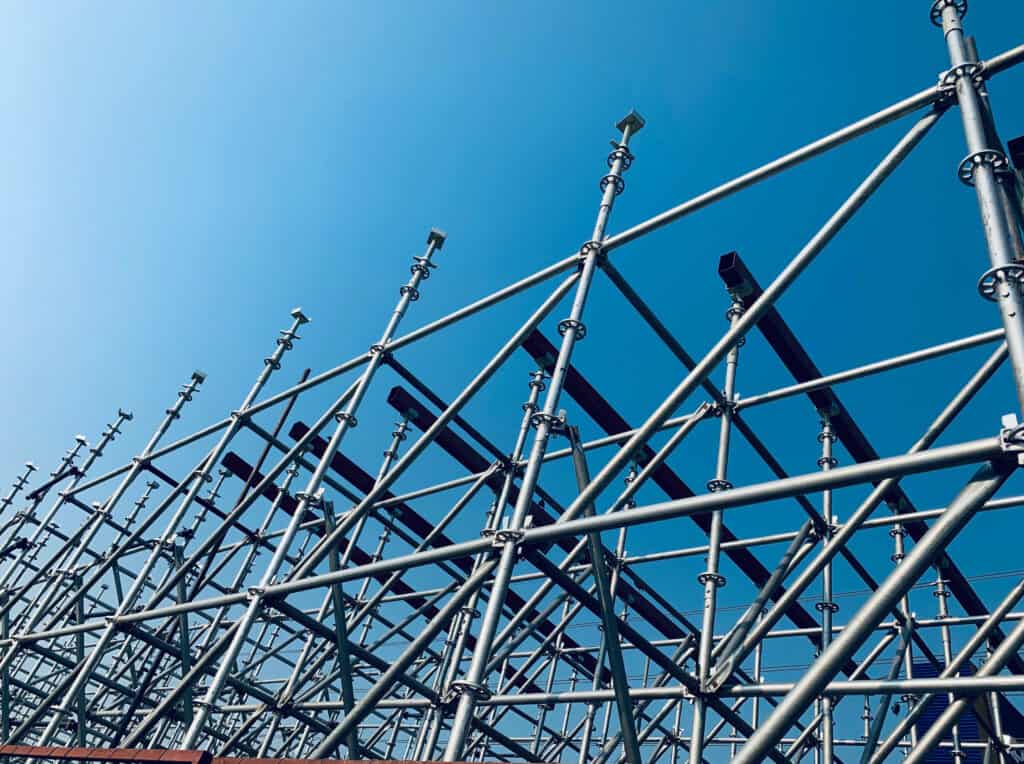
This is one reason modular systems such as ringlock and cuplock scaffolding remain important.
Standardized components can help with:
- Assembly and dismantling
- Inventory control
- Transportation
- Storage
- Component identification
- Repeated use
Fortune Business Insights estimates that supported scaffolding will account for approximately 59.79% of global scaffolding market revenue in 2026, while steel is expected to represent around 52.5% of the market by material.
Steel remains important for a simple reason: scaffolding is equipment that has to survive repeated use.
For many contractors and rental companies, the real value of a scaffold component is not how it looks when it leaves the factory.
It is how well it performs after the fifth, tenth or twentieth project.
Digital Tools Are Entering the Scaffolding Industry
The scaffold itself may still be steel or aluminum, but the way it is planned is changing.
BIM and 3D scaffold design tools are increasingly being used to visualize structures before erection.
They can support:
- Scaffold layouts
- Material quantities
- Access planning
- Component lists
- Construction sequencing
- Clash detection
For larger projects, this can make a real difference.
A missing ledger or incorrect quantity may look small on a spreadsheet, but on site it can stop an entire section from being erected.
Digital planning can help reduce that risk.
Still, technology is only part of the solution.
A good model cannot compensate for poor manufacturing.
Software cannot fix inconsistent dimensions.
And a digital inspection system does not replace competent people looking carefully at the scaffold.
The industry may be becoming more digital, but scaffolding remains a very physical business.
What Does This Mean for the Future of Scaffolding?
The future scaffolding market will probably not be defined by one dramatic new system.
The change is more gradual than that.
Projects are becoming more varied.
Buyers are asking more questions.
Documentation matters more.
Repeatability matters more.
Rental companies care about lifecycle value.
Contractors care about erection time.
Industrial users care about flexibility.
And distributors care about whether the next shipment will match the last one.
For manufacturers and suppliers, this means competition is slowly moving beyond price.
The future opportunity is not simply to manufacture more components.
It is to provide systems that are:
- Durable
- Consistent
- Easy to manage
- Adaptable to different projects
- Supported by reliable technical information
Conclusion
Global construction is expected to return to growth in 2026, while infrastructure, urbanization and energy investment continue to create long-term demand for temporary access.
That is good news for the scaffolding industry.
But growth also changes expectations.
A scaffold is no longer just a collection of standards, ledgers, braces and platforms delivered to a site.
For the people using it, it is part of the way the project gets built.
It needs to arrive on time.
It needs to fit.
It needs to work with the actual site conditions.
And after the project ends, much of it needs to be ready to do the same job again somewhere else.
That may be the most important way to think about the future of scaffolding.
The industry will grow with construction, but the companies that understand how scaffolding is actually used, managed and reused will be better prepared for what comes next.