Steel Scaffolding Grades: What Buyers Need to Know
Scaffolding is more than a temporary framework on a construction site. It supports workers, tools, materials and temporary loads at height, which means every load-bearing component must be strong, stable and reliable. One of the key factors behind this reliability is the steel grade used in the scaffolding system.
When buyers review drawings, quotations or material certificates, they may see steel grades such as Q235, Q355, S235, S275 and S355. These grades are not just technical names. They are related to yield strength, tensile strength, welding performance, forming quality, load capacity and long-term durability.
For contractors, rental companies and procurement teams, understanding steel scaffolding grades helps reduce project risk and avoid wrong material selection.
What Are Steel Scaffolding Grades?
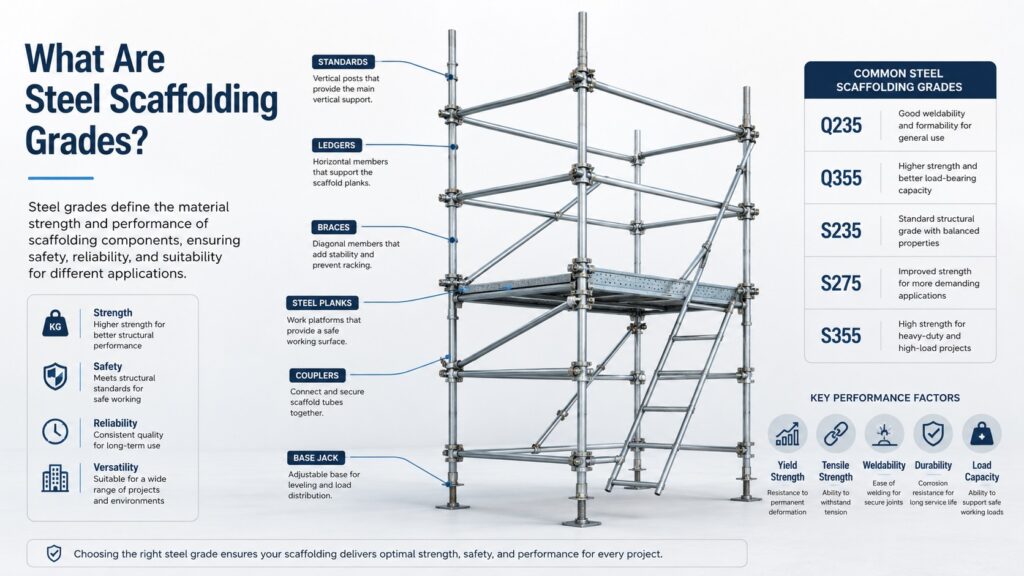
Steel scaffolding grades are the material classifications used to identify the strength, composition, and performance level of steel used in scaffolding systems. In simple terms, a steel grade tells buyers what kind of steel is used and whether it is suitable for specific scaffold components and project requirements.
For example, grades such as Q235, Q355, S235, S275, and S355 indicate different strength levels and material standards. These grades help manufacturers, engineers, contractors, and buyers understand how the steel may perform under load, during welding, after forming, and in different working environments.
In scaffolding, steel grades are commonly used for components such as ringlock standards, ledgers, braces, frames, steel planks, shoring props, jacks, couplers, and scaffold accessories.
A steel grade usually reflects several important properties:
- Yield strength
- Tensile strength
- Chemical composition
- Weldability
- Toughness
- Forming performance
- Suitability for surface treatment
Among these properties, yield strength is especially important. It indicates the stress level at which steel begins to deform permanently. For scaffolding systems, the selected steel grade must match the component design, loading condition, safety standard, and project environment.
However, steel grade should not be checked alone. Buyers should also review material certificates, welding quality, dimensional accuracy, hot-dip galvanized finish, inspection reports, and applicable project requirements.
Why Steel Grade Matters in Scaffolding Systems
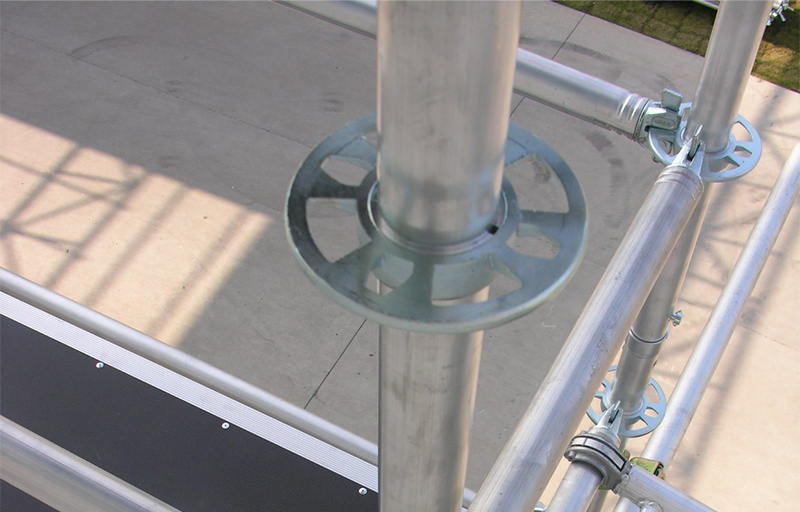
A scaffolding system is made of many connected parts. Each part must work together to transfer loads safely and maintain structural stability. Steel grade is only one factor, but it is the foundation of the system’s strength and reliability.
The right steel grade can affect:
- Load-bearing capacity
- Structural stability
- Resistance to deformation
- Welding quality
- Impact resistance during handling and installation
- Long-term durability
- Compatibility with hot-dip galvanizing
- Project compliance
- Total lifecycle cost
For international projects, steel grade is also important for approval. Some projects clearly specify required materials in drawings or technical documents. Using the wrong steel grade may cause inspection problems, delivery delays or rejection by the project owner.
It is also important to remember that scaffold safety is not determined by material alone. A safe scaffolding system depends on material selection, component design, manufacturing accuracy, surface treatment, inspection, correct installation and proper load control on site.
Common Steel Grades Used in Scaffolding
Different markets use different steel grade systems. In Chinese manufacturing and export, Q235 and Q355 are commonly discussed. In European and EN-related projects, S235, S275 and S355 are more common.
For example, buyers comparing tube and clamp scaffolding often need to confirm whether the scaffold tubes are made from Q235, Q355, S235 or other project-specified steel grades before approving production.
| Steel Grade | Common Market | Common Use in Scaffolding | Key Feature |
| Q235 | China / Asia / export projects | Frames, steel planks, accessories, light to medium-duty components | Cost-effective and widely used |
| Q355 | China / Asia / export projects | Ringlock scaffolding, heavy-duty parts, support systems and structural scaffold components | Higher strength than Q235 |
| S235 | Europe / EN-related projects | General scaffolding components | Common structural steel grade |
| S275 | Europe / UK-related projects | Medium-duty scaffold components | Higher strength than S235, lower than S355 |
| S355 | Europe / international projects | Heavy-duty scaffolding systems and structural components | Higher yield strength and stronger structural performance |
| ASTM A36 | North America / ASTM-related projects | Structural steel reference in some project documents | Common carbon structural steel |
| ASTM A500 | North America / ASTM-related projects | Used when structural hollow sections are specified | Often checked for structural applications |
| STK400 / STK500 | Japan / JIS-related projects | Market-specific structural steel references | Confirm according to JIS requirements |
| Q345 | Older Chinese drawings or previous quotations | Previous grade reference | Largely replaced by Q355 in current usage |
For current export communication, Q355 is usually a clearer and more updated material description than Q345. However, Q345 may still appear in older drawings, previous quotations or existing customer specifications.
Q235 vs Q355 Steel in Scaffolding
Q235 and Q355 are two common Chinese steel grades used in scaffolding manufacturing. The main difference is strength level.
Q235 is widely used for general scaffolding components because it offers good workability, stable availability and cost efficiency. It can be suitable for light to medium-duty components when the design and loading requirements allow.
Q355 has a higher nominal yield strength than Q235. In the current Chinese steel grade system, “355” refers to the yield strength level of 355 MPa. This makes Q355 more suitable for components that require higher strength and better structural performance.
For example, some structural scaffold components, such as cuplock scaffold verticals, may be specified with Q235 or Q355 depending on the height, load capacity and surface treatment requirements.
For scaffolding buyers, the choice between Q235 and Q355 should not be based on price alone. It should depend on:
- Scaffold system type
- Component function
- Required load capacity
- Project standard
- Welding and manufacturing process
- Surface treatment requirement
- Expected service life
In simple terms, Q235 is a practical choice for many general scaffolding components, while Q355 is often selected for heavier-duty components or projects with higher strength requirements.
What Happened to Q345? Q345 vs Q355 Explained
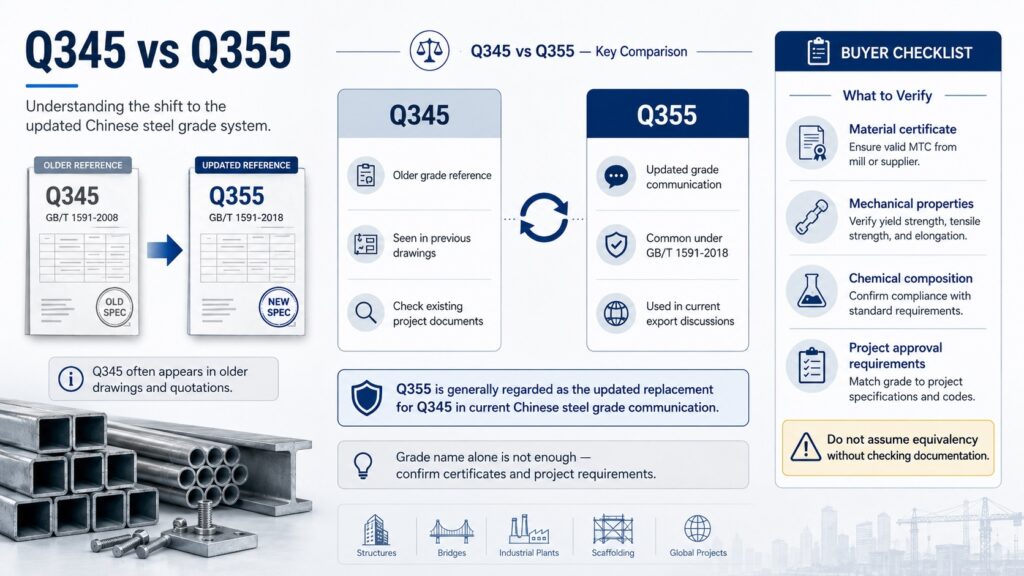
Many buyers still see Q345 in old drawings, previous quotations or existing project documents. This can cause confusion when suppliers now recommend Q355.
Q345 was commonly used under the older Chinese steel standard system. Under the updated GB/T 1591-2018 standard, Q355 is now commonly used as the updated grade.
For scaffolding projects, this means:
- Q345 may still appear in older technical documents.
- Q355 is now more common in updated material communication.
- Q355 is not only a new name; it belongs to the newer standard system.
- Buyers should not assume equivalency without checking certificates and project approval requirements.
A practical way to understand it is:
Q355 is generally regarded as the updated replacement for Q345 in current Chinese steel grade communication, but buyers should still confirm the material certificate, mechanical properties, chemical composition and project requirements before ordering.
S235, S275 and S355 Steel for International Scaffolding Projects
S235, S275 and S355 are common European structural steel grades under BS EN 10025-2 structural steel requirements. In general, the number in the grade name is related to the minimum yield strength level. S235, S275 and S355 are commonly associated with 235 MPa, 275 MPa and 355 MPa minimum yield strength levels respectively.
S235 is commonly used for general structural applications. It may be suitable for standard scaffolding components when the design loads are moderate.
S275 is a middle-strength option between S235 and S355. It may be selected in EN or UK-related projects when buyers need higher strength than S235 but do not require S355.
S355 has higher yield strength and is often used where stronger structural performance is required. It may be specified in heavier-duty projects, infrastructure applications or international projects with stricter material requirements.
For working platforms, buyers should also review the material, span, surface treatment and load requirements of different types of scaffolding planks, especially when steel planks are used in industrial or infrastructure projects.
Although Q235 is often compared with S235, and Q355 is often compared with S355, they should not be treated as automatically identical. They belong to different standard systems. Before confirming an order, buyers should check:
- Project standard
- Material certificate
- Chemical composition
- Mechanical properties
- Testing requirements
- Customer approval requirements
This is especially important for projects where compliance and documentation are part of the acceptance process.
Other Steel Grades Buyers May See in Scaffolding Projects
In addition to Q235, Q355, S235, S275 and S355, buyers may see other steel grades in international scaffolding projects. These grades are usually related to specific regional standards or project specifications.
ASTM A36
ASTM A36 may appear in North American or ASTM-related structural steel specifications. It is commonly referenced as a carbon structural steel grade with a minimum yield strength of around 250 MPa.
For scaffolding buyers, ASTM A36 should be checked according to the component type, project design and inspection documents.
ASTM A500
ASTM A500 is mainly associated with structural hollow sections in North American projects. Because ASTM A500 is closely related to structural hollow sections, it should only be used when the project specification clearly requires this standard.
For buyers, the key point is to confirm the required grade, product type, test method and approval documents before production.
STK400 and STK500
For Japanese or JIS-related projects, grades such as STK400 or STK500 may appear in material specifications. These grades are more closely related to structural steel applications under JIS requirements, so buyers should confirm the exact product type, mechanical properties, test report and approval documents before production.
For international projects, the most important point is not to choose a steel grade by name only. Buyers should always confirm the project standard, material certificate, mechanical properties, testing method and approval documents before production.
Steel Grade and International Standards
Steel grades should always be understood together with the standards required by the project. Different regions may use different standards for material selection, design, testing and scaffolding performance. For EN-related projects, buyers can also read more about EN 12811-1 for temporary works equipment, which covers performance requirements and general design for access and working scaffolds.
| Standard | Region / Market | Relevance to Scaffolding |
| GB/T 700 | China | Carbon structural steels, including Q235 |
| GB/T 1591 | China | High strength low alloy structural steels, including Q355 |
| EN 12811 | Europe / international projects | Performance requirements and general design for access and working scaffolds |
| EN 10025 | Europe | Structural steel grades such as S235, S275 and S355 |
| BS 1139 | United Kingdom / Commonwealth-related projects | Metal scaffolding components, couplers and fittings |
| AS/NZS 1576 | Australia / New Zealand | Design and operational requirements for scaffolding systems, equipment and scaffolds |
| ASTM A36 | North America / international references | Carbon structural steel reference |
| ASTM A500 | North America / ASTM-related projects | Structural hollow section reference |
| JIS G3444 | Japan / JIS-related projects | Structural steel reference for certain applications |
For buyers, the key point is simple: do not choose steel grade by name only. Always check the required standard, component type, test method and approval documents.
A steel grade may look similar to another grade in strength level, but the chemical composition, delivery condition, testing method and acceptance requirements may be different. This is why material certificates and inspection reports are important for international scaffolding orders.
Does Higher Steel Grade Always Mean Better Scaffolding?
Not always.
A higher steel grade usually means higher strength, but it may also increase cost. Some scaffolding components do not need high-strength steel if the load requirement is moderate and the design is suitable.
More importantly, steel grade alone cannot determine scaffold quality. A scaffolding system also depends on:
- Component design
- Welding quality
- Dimensional accuracy
- Surface treatment
- Inspection process
- Correct assembly
- Load control on site
A higher steel grade does not automatically make a scaffolding system better. The best choice is the steel grade that matches the scaffold design, load requirement, safety standard, project environment and budget.
For example, using Q355 or S355 may be reasonable for certain heavy-duty components, but Q235, S235 or S275 may still be suitable for other parts if the design and project standard allow it.
Steel Grade and Hot-Dip Galvanized Scaffolding
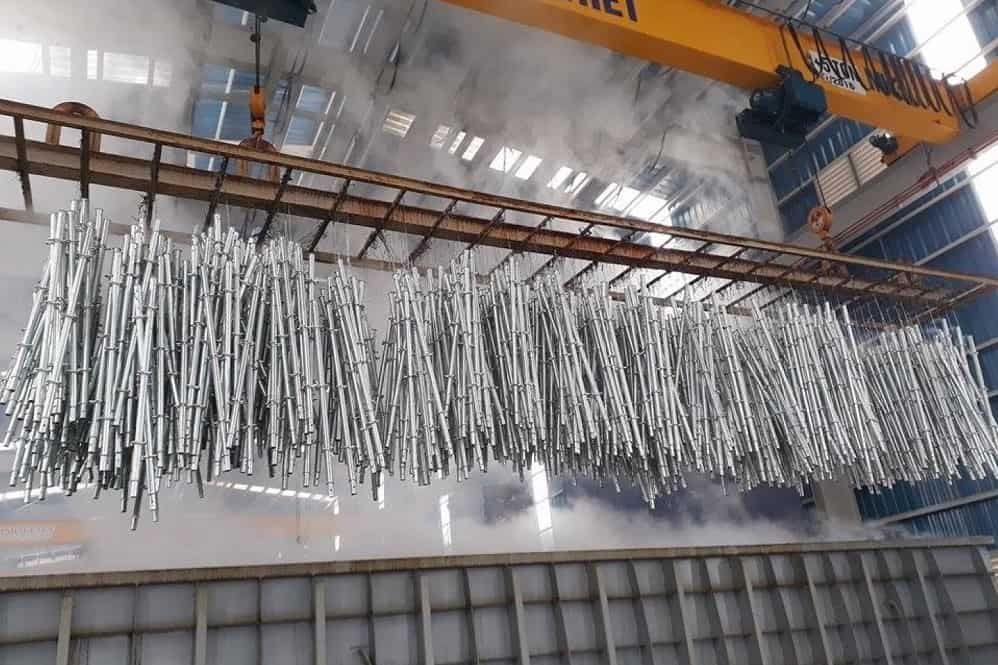
Steel grade determines the base strength of scaffolding components, while hot-dip galvanizing improves corrosion protection. For outdoor, humid, coastal or industrial projects, both material selection and surface treatment are important.
High-quality galvanized scaffolding requires:
- Suitable steel grade
- Reliable welding
- Proper hot-dip galvanizing
- Coating inspection
- Good packaging for transportation
Hot-dip galvanizing helps protect steel from rust and corrosion, which can extend service life and reduce maintenance costs. This is especially valuable for scaffolding used in outdoor construction, infrastructure, shipyards, industrial maintenance and long-term rental fleets.
APAC Scaffold provides hot-dip galvanized scaffolding components designed for demanding construction and industrial environments. Since surface treatment plays an important role in long-term scaffold performance, buyers can learn more in our related article: Hot-Dip Galvanized Scaffolding: Process and Benefits.
How to Choose the Right Steel Grade for Your Scaffolding Project
Choosing the right steel grade should start with the project requirements, not only the material price. Before confirming an order, buyers should ask several key questions:
- What type of scaffolding system is required?
- Is the scaffold used for access, support, maintenance or heavy-duty construction?
- What is the required load capacity?
- Which steel grade is specified in the drawing?
- Does the project require Q235, Q355, S235, S275 or S355?
- Is hot-dip galvanizing required?
- What standards should the scaffolding meet?
- Is the project located in a coastal, humid, industrial or corrosive environment?
- Are material certificates and inspection reports required?
- What is the expected service life?
- Does the project accept Chinese steel grades, or does it require EN, ASTM, AS/NZS or JIS-related standards?
If the project specification is unclear, it is better to confirm the material grade with the supplier before production. This helps avoid misunderstanding between drawings, quotations, certificates and final delivered products.
For international buyers, it is also important to confirm whether the project accepts Chinese steel grades or requires European, British, Australian, Japanese or North American standard systems.
Conclusion
Steel grade is a key factor in scaffold strength, safety, durability and project performance. Q235 and Q355 are common Chinese steel grades used in scaffolding systems, while S235, S275 and S355 are often used in international and EN-related projects. Q355 is also a more updated term than Q345 for current export communication.
However, the right steel grade should always match the scaffold system, load requirement, project standard, surface treatment and service environment. A good scaffolding product depends not only on raw material, but also on design, welding, galvanizing, inspection and correct use on site.
FAQ About Steel Scaffolding Grades
What steel grades are commonly used for scaffolding?
Common steel grades for scaffolding include Q235, Q355, S235, S275 and S355. The right grade depends on the project standard, component type, load requirement and target market.
Is Q355 better than Q235 for scaffolding?
Q355 has higher strength than Q235, but it is not always the best choice for every component. The correct selection depends on scaffold design, component function, load capacity, project standard and budget.
Is Q345 still used for scaffolding?
Q345 may still appear in old drawings, previous specifications or customer documents. However, Q355 is now more commonly used as the updated grade in current Chinese steel grade communication.
Is Q355 the same as S355?
No. Q355 and S355 are similar in strength level and are often compared, but they belong to different standard systems. Buyers should confirm chemical composition, mechanical properties, material certificates and project approval requirements before treating them as equivalent.
What is the difference between S235, S275 and S355?
S235, S275 and S355 are European structural steel grades with different strength levels. S275 is stronger than S235, while S355 has a higher strength level than both S235 and S275.
Does higher steel grade mean safer scaffolding?
Not necessarily. Steel grade is important, but scaffold safety also depends on design, welding quality, surface treatment, inspection, installation and load control.
What steel grade is used for ringlock scaffolding?
Ringlock scaffolding may use Q235, Q355, S235, S275 or S355 depending on project requirements, design loads and target market. Heavy-duty applications may require higher-strength steel.
Which standards should buyers check when choosing scaffolding steel?
Buyers may need to check GB/T 700, GB/T 1591, EN 12811, EN 10025, BS 1139, AS/NZS 1576, ASTM A36, ASTM A500, JIS G3444 or other local standards depending on the project location and product type.